
Kyle Arvisais
Socioeconomics as a Key Driver of Project Durability: Experiences from a Site Visit in Ghana
July 30, 2026
Socioeconomics and social durability are critical to forest carbon offset project design but are often overlooked compared to ecological durability concerns. Here, I share some of my experience visiting a developing project in Ghana and provide scientific resources suggesting projects that prioritize social durability generally have better long-term outcomes than projects that do not.
When we think of forest carbon offset project durability, the first things that typically come to mind are climatic events such as fire, drought, intense wind storms, or perhaps forest management regimes and the type of forest the project is managing. But sometimes project durability is influenced by people, culture, and socioeconomics. In fact, these factors are often key drivers of project durability depending on the project type, the location, and the project's implementation strategy. There is a growing body of research that shows projects that prioritize social durability experience better long-term outcomes relative to projects that do not.
In 2025, I traveled to Ghana to conduct a site visit for a project in the early stages of development. This is a community-based grouped afforestation, reforestation, and revegetation project that brought several communities in the region together to plant trees and restore native forest ecosystems. I interviewed the project developer and regional project manager to ask specific and detailed questions about project design and implementation, but I also had the opportunity to meet local stakeholders, including community members that would become project participants, community chiefs, nursery workers, and local government officials. The project developer and its partners understood the ecological challenges of restoring natural forests in Ghana, of course, and so did the community members, albeit from a different point of view than a forest ecologist. One village chief referred to tree sap (internal fluid within the xylem and phloem of a tree that transports water, nutrients, and sugars) as the "blood of the tree". While the ecological challenges of this project were real, they could be directly addressed with sound forest management practices rooted in the latest science. The greater risk to durability was regional socioeconomics.
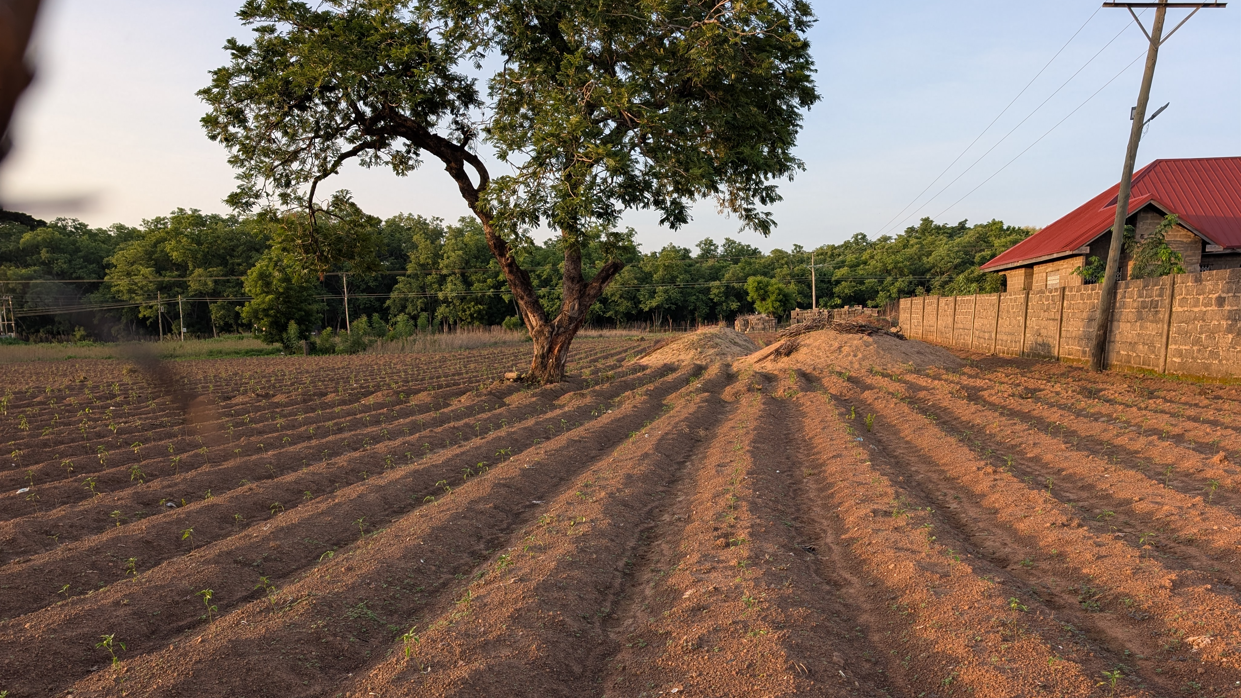
Communities in this region of Ghana live in small villages scattered across an agrarian landscape where subsistence agriculture is the dominant land use activity. Infrastructure is basic, with most people living in huts made of mud, clay, and grass. Some villages were still without electricity and most were at least somewhat reliant on outside assistance from government agencies or non-profit aid organizations for basic necessities. Every village depended on subsistence agriculture as its primary source of food and income. The most commonly grown crops were maize, cassava, yams, and ground nuts with some villages growing bell peppers or other subsistence crops. Goat herding was so common, you could find goats wandering around every village and even in the streets of larger towns and cities. The most common form of energy in rural Ghana is charcoal, which requires clearing large areas of trees using slash and burn practices then gathering the logs into burn mounds. Under these conditions, forest restoration is a low priority for communities and could actually hinder their ability to collect subsistence resources. Hence, the durability problem. If a forest carbon offset project wants to restore natural forests in a region where community members actively manage the land in a way that stifles forest regeneration, how can the project survive over the length of the durability period or beyond?
This specific project faced several clear socioeconomic durability problems: agricultural land use in the form of rotational subsistence farming and goat herding, charcoal production, and potential encroachment from migratory cattle grazers. It also faced a durability risk related to forest management culture, where community members would fell mature shea trees (Vitellaria paradoxa) that no longer produced fruit. The project addressed these risks in several ways:
First, it held regular meetings with community members, introducing them to what the project was trying to achieve. I attended one of these meetings and witnessed the project team in action. They created signs and billboards written in English and the local language (there are over 80 official languages spoken in Ghana) along with pictograms and verbal explanations for those less literate. The sessions were held in a Q&A format rather than the project workers lecturing to the communities. Community members appeared interested and excited, mostly about the idea of receiving financial benefits for growing trees.
Second, the project involved communities in the planning process. Implementation plans were designed around community land use, family farm plots, goat herding locations, and charcoal usage.
Third, the project's benefit sharing and implemented activities directly addressed the economic needs of community members. It provides direct financial payments to villages, it grows woodlots to centralize and contain charcoal and fuelwood production, it implements agroforestry to supplement and bolster agricultural production, and it works with villages to isolate restoration areas from goat and cattle herds. It also grows longer-term mahogany plantations for species enrichment, but community members can harvest small chunks of mahogany bark for medicinal uses.
This project is being implemented using the latest understandings of socioeconomic dynamics and how they relate to the successful implementation of forest carbon offset projects. It has the benefit of learning from many similar projects that came before it, many of which were not as prepared to address social durability risks. Projects don't always need to be community-based projects in developing nations to consider social durability either. Issues such as land tenure, local governance, and cultural traditions can affect project durability almost anywhere. Researchers and project developers are constantly trying to better understand how to improve project quality, and socioeconomics is quickly becoming a focal point in project design. So too are third party reviewers, such as EldHollow, building socioeconomic factors into their criteria.
For more information on socioeconomics and social durability as it relates to forest carbon offset projects, consider the following resources:
Lawlor, K., Madeira, E. M., Blockhus, J., & Ganz, D. J. (2013). Community participation and benefits in REDD+: A review of initial outcomes and lessons. Forests, 4(2), 296–318. https://doi.org/10.3390/f4020296
Nyengere, J., Tholo, H. M., Kumpolota, S., Njala, A. L., Jamali, A., Chalulu, T., Akai, J., Gremu, C., Kambanje, M., Kuwali, P., Masuku, P., Chisenga, C., & Tham-Agyekum, E. K. (2026). Forestry-based carbon financing mechanisms and their role in advancing sustainable forest management: A systematic review. Trees, Forests and People, 25, 101270. https://doi.org/10.1016/j.tfp.2026.101270
Pan, C., Shrestha, A., Innes, J. L., Zhou, G., Li, N., Li, J., Wang, G., & Niles, J. O. (2022). Key challenges and approaches to addressing barriers in forest carbon offset projects. Journal of Forestry Research, 33(4), 1109–1122. https://doi.org/10.1007/s11676-022-01488-z
Wong, G. Y., Loft, L., Brockhaus, M., Yang, A. L., Pham, T. T., Assembe-Mvondo, S., & Luttrell, C. (2016). An assessment framework for benefit sharing mechanisms to reduce emissions from deforestation and forest degradation within a forest policy mix. Environmental Policy and Governance, 26(6), 479–492.
Wunder, S., Börner, J., Sills, E. O., Kontoleon, A., & colleagues. (2024). Modest forest and welfare gains from initiatives for reduced emissions from deforestation and forest degradation. Communications Earth & Environment, 5, Article 466.
Yan, Y., Zheng, Q., Miao, X., & Wei, Y. (2026). Does achieving the sustainable development goal of forest carbon sinks need to come at the expense of the stakeholders' benefits? Global perspective through systematic literature review. Humanities and Social Sciences Communications, 13, Article 238.